How Can Insurers Screen for Mis-Selling Risk When Hiring Sales Staff?
Insurers can screen for mis-selling risk before a salesperson sells a single policy, by testing how candidates behave when a sale and the customer's interest pull in different directions. The regulator now says the same: IRDAI's chairman told insurers to do due diligence when hiring sales staff, and to reward suitable advice instead of only sales volume. This post explains why that matters, what the numbers show, and which questions and checks help.
What is mis-selling in insurance, and how big is the problem?
IRDAI describes mis-selling as selling a product without adequate disclosure of its terms, conditions or suitability for the buyer. In its annual report for 2024-25, the regulator called mis-selling "a significant concern" and asked insurers to carry out root-cause analysis, check product suitability and put controls in each distribution channel (IRDAI annual report, via Business Standard, December 2025).
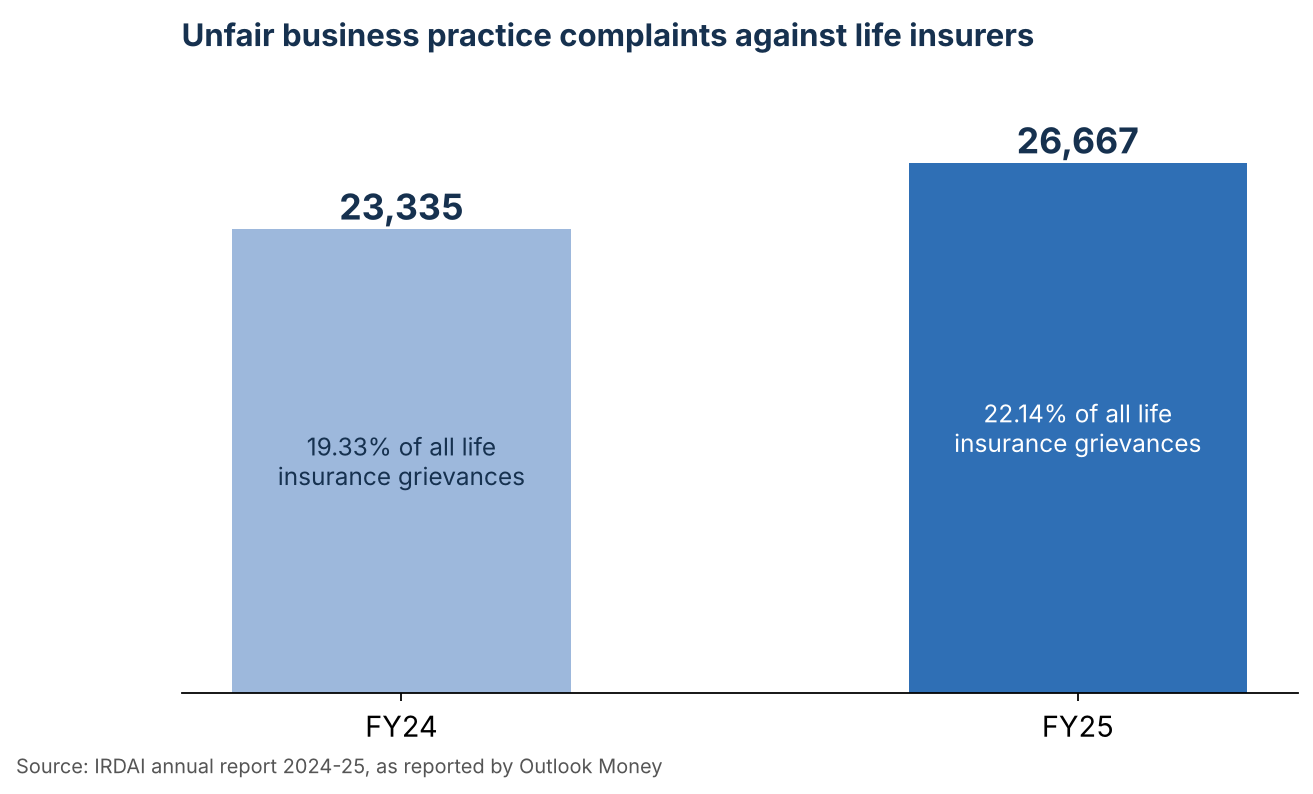
The complaint numbers show why. Complaints about unfair business practices against life insurers, which is the category that covers mis-selling, rose from 23,335 in FY24 to 26,667 in FY25. They now make up 22.14% of all life insurance grievances, up from 19.33% (IRDAI annual report 2024-25, via Outlook Money, January 2026).
Measure | FY24 | FY25 |
|---|---|---|
Unfair business practice complaints, life insurers | 23,335 | 26,667 |
Share of all life insurance grievances | 19.33% | 22.14% |
Source: IRDAI annual report 2024-25, as reported by Outlook Money.
At the same time, business is doing well. Life insurers' profit rose about 18% to ₹56,006 crore in FY25 (Business Standard, December 2025). Growth is coming, and so is scrutiny, which means insurers need sales staff who can grow the business without creating complaints.
Why is the regulator now looking at who sells?
Because today, records usually show only the bank or broker that sold a policy, not the person who advised the customer. In July 2026, IRDAI chairman Ajay Seth proposed that every policy should be traceable to the individual salesperson, agent or POSP behind it. He said such a database does not exist at present, and that the gap is most visible in bancassurance and broker-led sales. He also said that if a complaint is genuine, those responsible must be held accountable (reported by NewsBytes, 26 July 2026).
Two of his other points are directly about hiring. Insurers should do due diligence when hiring POSPs, and their work history should stay visible when they change jobs. And incentive structures should reward suitable advice, not just sales volume.
If a policy can be traced back to a person, then who you hire becomes a compliance question, not only a sales one.
What should you check before you hire an insurance salesperson?
Start with what you can verify. Check the current requirements for the role on the regulator's own site rather than from memory or an old checklist: the IRDAI website lists the regulations for agents and other intermediaries. A pre-joining checklist helps:
Check | What you are looking for |
|---|---|
Eligibility and licensing | The candidate meets the current IRDAI requirements for the role, or will before they start selling |
Work history | Past roles, reasons for leaving, and any gaps that need an explanation |
References | A conversation with a former manager about how the person handled targets and customer complaints |
Identity and KYC | Documents match, and the person can be traced to a role and a branch |
These checks are our suggestions for a sensible process, not an official IRDAI list. Where the rules apply to your role, follow the rules first.
Which interview questions reveal how someone behaves under target pressure?
Ask scenario questions, not "do you believe in ethical selling?" Everyone says yes to that. A scenario forces a choice. Here are five you can use, with what to listen for. These are our suggestions, not a regulatory standard.
Scenario | A good answer | A warning sign |
|---|---|---|
A customer in their 60s wants a safe place for savings. The product that pays you the most is a long-term plan. | Asks about their needs and timeline, explains the lock-in, and says if the product does not fit | Pushes the long-term plan because of the commission |
You have hit only 20% of your monthly target with three days left. | Talks about finding more genuine leads and asking for help | Talks about "convincing" people, bundling, or promising returns |
A customer asks, "Is this guaranteed?" and the answer is "partly." | Explains clearly what is guaranteed and what is not | Gives a vague answer that sounds like "yes" |
A colleague closes many sales quickly, and you suspect they skip the explanation. | Would raise it with a manager or compliance | Would copy the method, or ignore it |
A customer says they did not understand what they bought and asks to cancel. | Helps them with the process and the free-look rules | Tries to talk them out of it |
Note the answers, not only whether they sound confident. A good candidate will sometimes say "I would lose that sale," and that is a good sign.
How do you build in good behaviour after hiring?
Screening is only the first layer. IRDAI's chairman pointed at incentives, and he is right: if pay depends only on volume, even a well-screened person will drift. Three changes help.
First, train before people sell. A structured start, like the one we describe in train-and-hire in Indian banking, should include product disclosure and suitability, not just product features.
Second, track the quality of sales, not only the count. Look at complaints and early cancellations for each salesperson and each manager, and talk about them in reviews.
Third, mix incentives. Where possible, give part of the reward for customer outcomes, such as policies that stay active, and not only for the number sold.
This also helps retention. Frontline staff leave fast when targets feel impossible; we look at the numbers in our 2026 BFSI hiring trends post.
How can TheCareerVista help?
We hire for banks, insurers and NBFCs across India. If you want to add scenario-based screening to your hiring process, or need to fill insurance sales roles, talk to our team. If any term in this post is new, our plain-English glossary of BFSI hiring terms explains it.
Frequently asked questions
What is mis-selling in insurance?
Selling a policy without adequate disclosure of its terms, conditions or suitability for the customer. IRDAI calls it a significant concern in its 2024-25 annual report.
How many mis-selling complaints did life insurers get in FY25?
Complaints about unfair business practices against life insurers were 26,667 in FY25, up from 23,335 in FY24, according to IRDAI's annual report as reported by Outlook Money.
Can insurers be held responsible for what their salespeople do?
IRDAI has asked insurers to look at the root causes of mis-selling and to set controls for each distribution channel. Its chairman has also said those responsible for genuine complaints must be held accountable, and has proposed tracing each policy to the individual who sold it. For the exact legal position, read the regulations on the IRDAI website or speak to your compliance team.
How can I test a candidate's ethics in an interview?
Use scenario questions where the sale and the customer's interest conflict, such as a commission-heavy product for a customer who needs something simple. Listen for whether the candidate asks about the customer's needs and is willing to lose the sale.
Last updated October 2026. Figures are from the sources below; check the original before you quote them. This post is general information, not legal advice.
Sources
IRDAI annual report 2024-25 on mis-selling, via Business Standard (30 December 2025): Business Standard on IRDAI calling mis-selling a significant concern
IRDAI annual report complaint figures, via Outlook Money (January 2026): Outlook Money on FY25 insurance complaints
IRDAI chairman's proposal to trace policies to individual sellers, via NewsBytes (26 July 2026): NewsBytes on the proposal to trace every policy to its seller
Regulations for agents and intermediaries: IRDAI regulator website