Train-and-Hire in Indian Banking: How It Works, Week by Week
Train-and-Hire in Indian Banking: How It Works, Week by Week
Train-and-hire means a bank selects candidates first, trains them for the exact role, and only then puts them on the job. In India these programmes run from about two weeks to a year, and the candidate usually holds a provisional offer from day one. Banks use them because attrition among new staff is high and training after joining often comes too late.
What is train-and-hire?
Train-and-hire is also called hire-and-train. The order is the point: a candidate is selected through an aptitude test and an interview, receives a provisional offer, then trains, and then joins as an employee (Become Banker).
Programme length varies a lot. Manipal Academy of BFSI lists courses from 2 weeks to 1 year, with stipends during training (Manipal Academy of BFSI). TeamLease EdTech describes a 12-month model with four phases: hire, train, deploy and absorb (TeamLease EdTech).
The difference from ordinary recruitment is simple. In direct hiring, the bank trains after the person joins. In train-and-hire, the person is already trained for the role on day one.
Why do banks use it?
The main reason is early attrition. The Reserve Bank of India's Report on Trend and Progress of Banking in India 2023-24 put average attrition in private sector banks at about 25%, and said it had increased sharply over three years (Moneylife). Reports on the same RBI document say it suggested better onboarding, and training, mentorship and clear growth paths (Risk Management Association of India).
Train-and-hire builds those three things in before the first day. The candidate knows the products, has practised the sales process and has met their mentor. We explain the causes of early exits in Why Do New Relationship Managers Quit Within a Year?
How does a programme run, step by step?
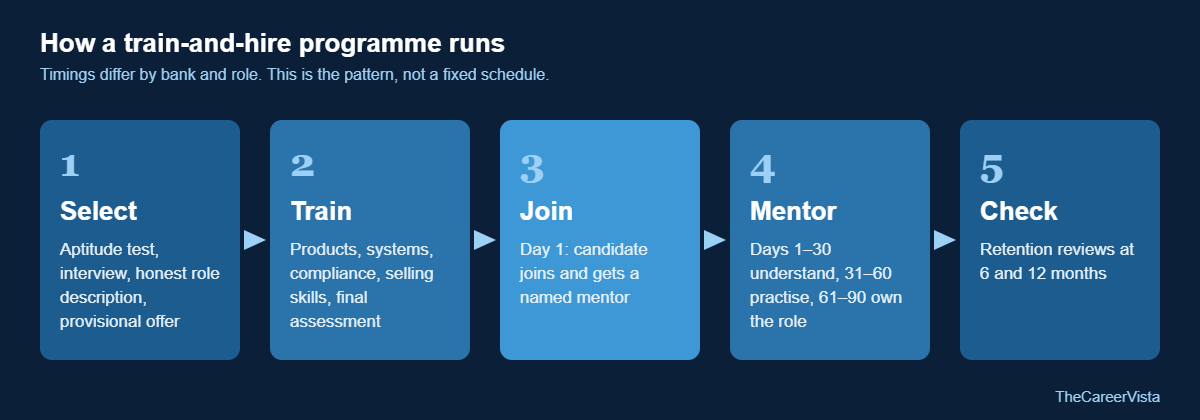
A typical programme has eight steps, from selection to the twelve-month check. Timings differ by bank and by role, so read the table as a pattern, not a fixed schedule.
Step | When | What happens | What to track |
|---|---|---|---|
1. Selection | Before training | Aptitude test and interviews. Candidates get an honest description of targets, incentives, field work and certifications. A provisional offer follows. | Offer acceptance |
2. Classroom training | Weeks to months | Products, systems, compliance and selling skills. | Attendance, assessment scores |
3. Practice and assessment | End of training | Role plays, mock customer calls and a final assessment. | Pass rate |
4. Joining | Day 1 | The candidate joins and gets a named mentor. | Offer-to-joining ratio |
5. Understand | Days 1–30 | Products, systems, compliance and customer segments. The goal is a solid base, not instant expertise. | Exits by day 30 |
6. Practise | Days 31–60 | More time with real customers. The mentor reviews calls, follow-ups and pipeline. | Exits by day 60, activity levels |
7. Take ownership | Days 61–90 | The new RM works more independently. Manager and mentor review progress and talk about the career path. | Exits by day 90 |
8. Retention checks | Months 6 and 12 | Review who stayed, who left and why. | Retention at 6 and 12 months |
What do candidates learn?
Good training teaches the job, not only the product. For frontline BFSI sales roles it should cover:
Products and systems: the loans, accounts, cards or insurance plans they will sell, and the software they will use.
Compliance: the rules around KYC, disclosure and, for insurance, IRDAI certification.
Selling skills: opening a conversation, handling a "no", following up and building a pipeline.
Customer handling: listening to needs and dealing with complaints.
Targets and incentives: how the monthly number is set and how pay is worked out, so there is no surprise later.
The last point matters more than it looks. Many early exits start when the job turns out different from what the candidate was told.
How do you know the training worked?
Do not judge a programme by how many people sat the course. Track every candidate through the full journey and look for where the biggest drop happens:
Assessment pass rate at the end of training
Offer-to-joining ratio
Exits at 30, 60 and 90 days
Activity levels in the first three months, such as calls and follow-ups, not only the final number
Retention at six and twelve months
Write down the definition each time (90-day, first-year, voluntary only). Attrition figures are not interchangeable unless they are counted the same way.
When does train-and-hire beat direct hiring?
Our view: train-and-hire wins when you hire many entry-level people at once. Direct hiring wins when you need one experienced person soon.
Train-and-hire | Direct hiring | |
|---|---|---|
Best for | Batches of freshers and entry-level sales roles | Experienced hires, senior roles, small numbers |
Skills on day 1 | Trained for the exact role and the bank's products | Depends on the candidate's last employer |
Consistency | Every candidate in a batch gets the same training | Varies person to person |
Cost | Training cost, and often a stipend. Some programmes charge candidates fees and some are free, so ask who pays | Recruitment fee, plus the bank's own induction after joining |
Main risk | Some candidates drop out during training | The hire may not fit the role after joining |
Time | Longer before the person is on the job | Faster to fill a single seat |
The cost row is the one HR teams most often ask about. There is no single price. It depends on the length of training, the stipend and who pays it, so get this in writing before you sign with any partner.
How we run train-and-hire
We source, train and mentor. We have trained more than 1,000 people through induction and train-and-hire programmes for more than 5 clients, and every programme includes a 90-day mentoring component. See our Training & Development service.
Our cohort data: [TO ADD from Ashish: typical batch size, training length, assessment pass rate, offer-to-joining ratio and retention at 90 days, with the period they cover]
A client example: [TO ADD: one anonymised case, such as "a leading private sector bank". Do not name the client without written permission]
What should you ask a training partner?
Who pays for the training and the stipend, and what happens if a candidate drops out?
How are candidates selected, and do they get an honest role description before the offer?
What does the training cover beyond products?
How is training effectiveness measured, and can you see the results?
Is there mentoring after joining, and for how long?
Can you see retention at 90 days and 12 months from earlier batches?
FAQ
What is a train-and-hire model in banking?
Candidates are selected and given a provisional offer, then trained for the role, and then join the bank as employees.
How long does a train-and-hire programme last?
It varies. Public programmes range from 2 weeks to 1 year, and one provider describes a 12-month model.
Who pays for the training?
That depends on the programme. Some charge candidates fees, some are free, and many pay a stipend during training. Always confirm in writing.
How is it different from campus hiring?
Campus hiring selects students near graduation. Train-and-hire adds role-specific training before the person joins, so they start with the skills the job needs.
Does train-and-hire reduce attrition?
Providers list lower early turnover as a benefit, but we found no public figures. Measure it yourself: compare exits at 30, 60 and 90 days for trained and directly hired batches.