How Do You Hire 100 Sales Staff in a Tier 3 City? What Changes and What Doesn't
Hiring 100 sales staff in a tier 3 city is the same job as hiring them in a metro, with four things changed: where you find people, which skills you screen for, how you set pay, and how you keep them past the first quarter. The steps (job description, screening, interviews, offers, joining) stay the same. What changes is how long each takes and what goes wrong.
This matters because BFSI hiring is moving there. Here is what the data says, and what we would change in the plan because of it.
Why are banks and insurers hiring in tier 3 cities now?
Because that is where a growing share of the jobs are. Adecco India found that nearly 48% of new BFSI roles now come from tier II and III cities (Adecco India, August 2025). A separate 2026 hiring outlook by Taggd and CII puts tier 2 cities at 32% of projected jobs across sectors, and tier 3 at 15% (Taggd and CII, November 2025).
Branch networks are growing in the same direction. SBI said it plans to hire about 16,000 people a year and open 200 to 300 branches in FY26, with the focus on semi-urban and rural areas and underserved regions (People Matters, December 2025).
City group | BFSI hiring growth | Source |
|---|---|---|
Indore, Coimbatore, Nagpur, Guwahati | 15% to 18% | Adecco India |
Surat, Jaipur, Lucknow, Bhubaneswar | 11% to 13% | Adecco India |
Source: Adecco India BFSI report, as reported by Business Today (6 July 2026).
What stays the same when you hire 100 people outside a metro?
Quite a lot. You still need a clear role definition, an honest target and incentive structure, a structured interview, background and KYC checks, and a training plan before the person sits at a desk. Skipping any of these costs you more in a small town, not less, because the local pool is smaller and word travels fast.
The sales skills you want are also the same: can the person talk to a stranger, explain a product in plain words, and follow up without being chased. If any hiring term in this post is new to you, our plain-English glossary of BFSI hiring terms explains it.
What changes: where you find candidates
In a metro, you can lean on job portals and the big recruiter networks. In a tier 3 city, many of your best candidates will not be on them. Taggd's guidance on hiring frontline sales teams in tier 2 and 3 cities points to regional colleges, polytechnics and ITIs, hyperlocal job boards, community WhatsApp and Facebook groups, vernacular content and employee referrals (Taggd, February 2026). That article is written about FMCG, but the sourcing channels apply to any frontline sales role.
A practical plan: pick three channels, such as local colleges, referrals from your existing branch staff, and a regional job board, and run all three in the first two weeks. Track which one produces joiners, not just applicants.
What changes: language and local knowledge
Adecco India says candidates with local-language skills and grassroots sales experience are about 2.5 times more likely to be shortlisted, and they earn 10% to 15% more (Adecco India, August 2025). The reason is simple. A relationship manager or insurance officer who speaks the customer's language and knows the town closes more conversations.
For your job description, this means writing "fluent in Hindi and the local language" as a requirement, not a nice-to-have, and running part of the interview in that language. Do not reject a candidate only because their English is basic, if the role is customer-facing in the local market.
What changes: pay and offer expectations
Expect two surprises. First, pay bands are lower than in metros, but candidates with local skills may ask for more than your budget, because the market is rewarding them (see the 10% to 15% premium above). Second, at the entry level a small difference matters a lot. TeamLease's Krishnendu Chatterjee said junior staff often move "in search of a quick raise," and with starting salaries around ₹15,000 a month, a ₹1,000 increase can be enough to make someone switch (TeamLease, via All Things Talent, February 2025).
So check what nearby employers actually pay before you fix your band, and explain the incentive structure clearly in the first conversation. Surprises at the offer stage lead to dropouts before joining.
What changes: attrition and what it costs you
This is the part that hurts most at scale. TeamLease, which manages more than 80,000 frontline BFSI employees, reported overall attrition of 103% in its frontline workforce, with NBFCs at 77% and insurers at 62% (TeamLease, via All Things Talent, February 2025). Those are national figures, not tier 3 figures, so use them as a warning rather than a forecast.
For smaller cities, the only figure we found is from a related sector. Taggd reports that FMCG frontline sales teams in tier 2 and 3 cities see 28% attrition against an 18% national average, and it names reluctance to move from home towns and a preference for metro jobs as drivers (Taggd, February 2026). Treat this as a signal, not a BFSI number.
What helps is not complicated: train before you deploy, give each new hire a mentor, and review them in the first 30, 60 and 90 days. We describe this in train-and-hire in Indian banking. The RBI itself has urged banks to invest in career development, mentorship and a supportive workplace.
How many candidates do you need to hire 100?
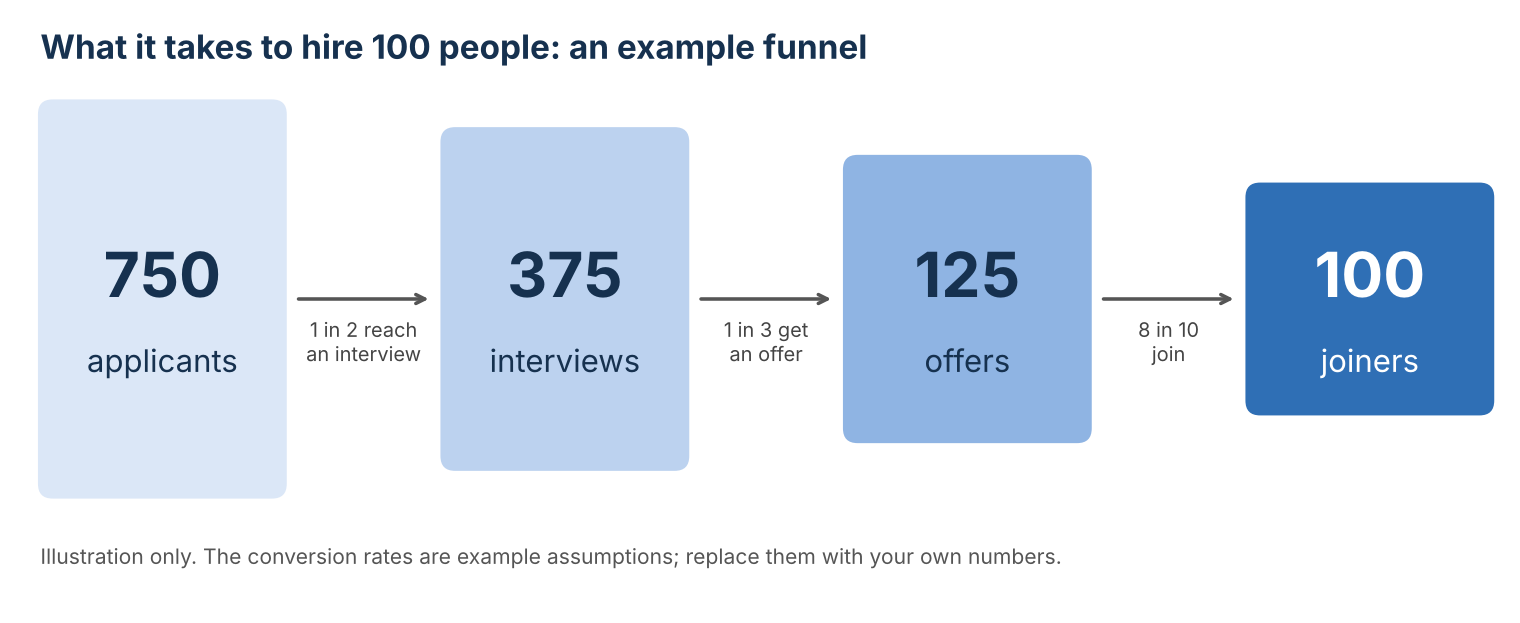
You will need many more than 100 applicants, and the exact number depends on your own conversion rates. Here is how to work it out backwards, with an example. These numbers are an illustration, not data.
Step | Example assumption | What you need |
|---|---|---|
Joiners wanted | 100 | 100 |
Offers that turn into joining | 8 in 10 join | 125 offers |
Interviewed candidates who get an offer | 1 in 3 | about 375 interviews |
Applicants who reach an interview | 1 in 2 | about 750 applicants |
Replace the assumptions with your own numbers from the last hiring round. If you do not have them, start tracking them this week. They tell you how big your sourcing needs to be and how long it will take.
What should your first 30 days look like?
Four things, in order. Set the role and pay band after checking local salaries. Open three sourcing channels at once. Run the first interview round in the local language alongside English where needed. And book your training room and mentors before the first offer goes out, not after.
If you would rather not do this alone, talk to our team about hiring in tier 2 and tier 3 cities. We work with banks, insurers and NBFCs across India. For more data on where BFSI hiring is heading, see our 2026 BFSI hiring trends post.
Frequently asked questions
How long does it take to hire 100 sales staff in a tier 3 city?
It depends on your funnel and your channels, so there is no single number. We have not found a reliable published figure for BFSI in smaller cities. Work backwards from your own interview-to-offer and offer-to-joining rates, as in the table above.
Should I hire local candidates or relocate people from metros?
Mostly local. Adecco India found that candidates with local-language skills and grassroots experience are 2.5 times more likely to be shortlisted. Relocated staff can work for a few senior or specialist roles, but they are harder to retain in smaller towns.
Do tier 3 candidates cost less to hire?
Base pay is usually lower than in metros, but candidates with local skills can earn 10% to 15% more than others, according to Adecco India. Plan for training and retention costs too, since replacing a person costs sourcing, training and lost sales.
Are BFSI jobs really growing in smaller cities?
Yes. Nearly 48% of new BFSI roles come from tier II and III cities (Adecco India), and SBI plans 200 to 300 new branches in FY26 with a focus on semi-urban and rural areas.
Last updated October 2026. Figures are from the sources below; check the original before you quote them.
Sources
Adecco India BFSI hiring report, via Outlook Business (PTI, 21 August 2025): Outlook Business report on BFSI hiring shifting to tier II and III cities
Adecco India city growth figures, via Business Today (6 July 2026): Business Today on tier II and III cities in BFSI hiring
Taggd and CII hiring outlook 2026, via IANS (11 November 2025): IANS report on 2026 hiring intent
SBI hiring and branch plans, People Matters (December 2025): People Matters on SBI hiring 16,000 a year
TeamLease frontline attrition, via All Things Talent (7 February 2025): All Things Talent on 103% frontline attrition
FMCG recruitment challenges in tier 2 and 3 cities, Taggd (13 February 2026): Taggd guide to tier 2 and 3 recruitment challenges