What Do Banks Ask in a Relationship Manager Interview? 25 Questions and Answers
A bank relationship manager interview usually has two or three rounds, and the first question is almost always "tell me about yourself." After that, interviewers test three things: how you sell, how you look after customers, and whether you know basic banking. Below are 25 questions that candidates report for relationship manager roles in India, with plain advice on how to answer each one.
The demand is there. Adecco India names sales and relationship executives among the most sought-after banking roles, and projects nearly 2.5 lakh permanent BFSI jobs by 2030 (Adecco India, August 2025). Most of those hires will sit across an interview table from someone with the same questions.
Where do these questions come from?
They come from candidate reports on AmbitionBox and from interview-prep guides for HDFC Bank and ICICI Bank published by Internshala and foundit. The samples are small. AmbitionBox, for example, lists six interview reviews for the relationship manager role at Federal Bank. Treat the list as a guide to what to expect, not a promise of what you will be asked. Every bank and every branch is different.
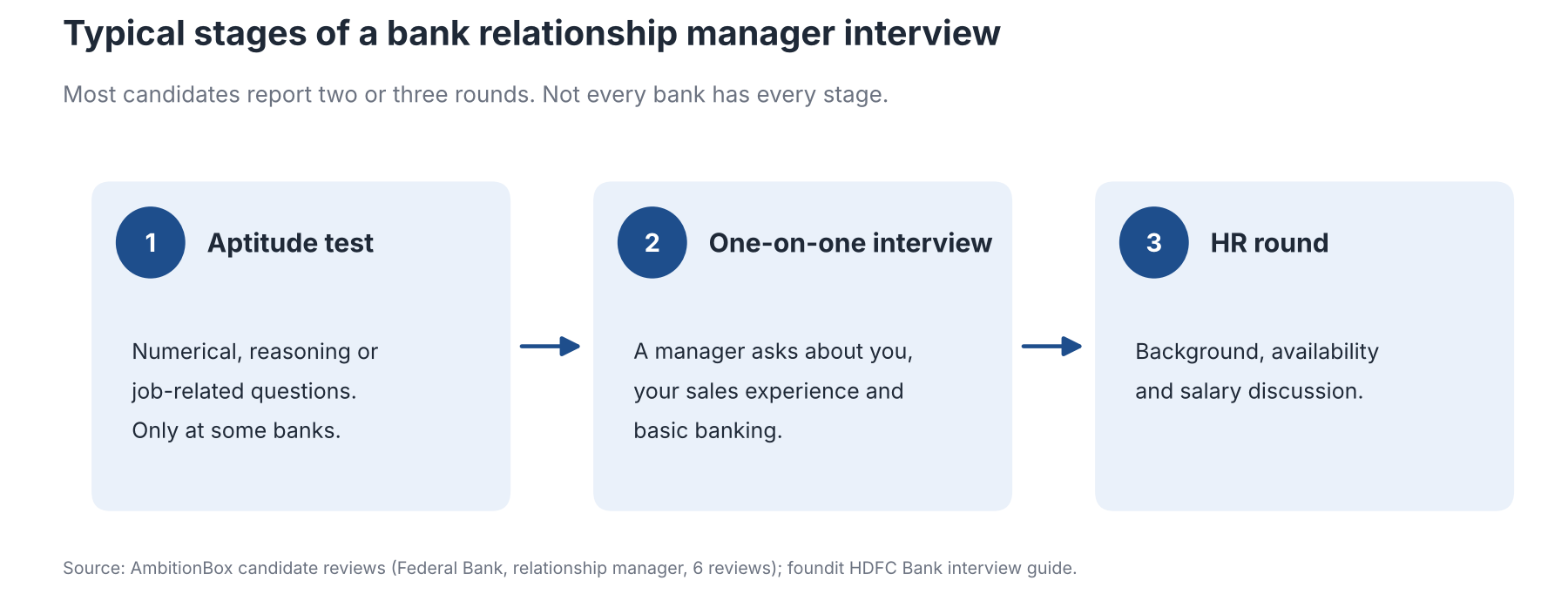
How many rounds are there in a bank RM interview?
Two or three is the most common, according to AmbitionBox's reviews. The exact mix depends on the bank and on whether you come through campus, a walk-in or an online application.
Stage | What happens |
|---|---|
Aptitude or written test | Numerical, reasoning or job-related questions. Not every bank has this stage. |
One-on-one interview | A manager asks about you, your sales experience and basic banking. |
HR round | Background, communication, availability and salary discussion. |
Source: AmbitionBox candidate reviews (Federal Bank, relationship manager) and foundit's HDFC Bank interview guide. Of the six AmbitionBox reviews, half rated the difficulty easy and half moderate.
Questions about you
1. Tell me about yourself.
This is the most reported question. Take 60 to 90 seconds: what you do or study now, one thing you are proud of, and why banking is the next step. Do not read your CV out loud.
2. Why do you want to work in banking?
Give a real reason, such as helping people plan their money or building long relationships with customers. "Job security" alone sounds weak. Interviewers want to hear that you will stay.
3. Why do you think you are a good fit for this bank?
Do your homework before the interview. Read the bank's products and branch network on its official website, and connect one thing you have done to what the role needs. If you speak the local language of the city, say so. Adecco India found that candidates with local-language skills and grassroots sales experience are 2.5 times more likely to be shortlisted.
4. Why are you leaving your current job?
Talk about growth, not complaints. "I have learned what I can in this role and want to take on more" works. Do not blame your manager or your company.
5. How would your former colleagues describe you?
Pick one or two traits and back each with a short example, such as "dependable, because I covered a colleague's customers during a transfer." One real example beats a list of adjectives.
Questions about sales and targets
6. What sales methods are you familiar with?
Name the ones you have actually used, such as referrals, branch walk-ins, cross-selling to existing customers or follow-up calls, and say which worked best. If you are a fresher, describe how you would start.
7. How do you find new business?
Be specific about channels. Referrals from happy customers, local contacts, colleges and community groups are the sources that tend to work outside the metros. Show that you would build a small pipeline, not wait for walk-ins.
8. Tell me about a deal you closed.
Use a simple order: the situation, what you did, and the result with a real number. If you have no banking sales experience, use a campus, part-time or family-business example. Never invent figures. Interviewers check.
9. How do you deal with rejection or missing a target?
Say plainly that it happens. Then explain what you do: review who you called, ask a senior for help, adjust your approach and keep following up. Add that you would never push a product that does not suit the customer. Banks care about this.
10. "Sell me this pen."
Do not start listing features. Ask first: who is it for, what do they write, what do they dislike about their current pen? Then match the pen to the answers. The question is testing whether you listen before you sell.
11. Tell me about a time you failed.
Pick a real, small failure, say what went wrong, and spend most of your answer on what you changed afterwards. A campaign that missed its goal and the lesson you took from it is a safe choice.
Questions about customers
12. How would you approach a new client?
Start by finding out about them: income, goals, what they already hold with other banks. Pitch only after you understand the need. Then say you would follow up in a few days, not once.
13. How do you prioritise many client relationships at once?
Explain a simple system. Sort clients by value and urgency, keep a tracker with next-contact dates, and set aside fixed time for follow-ups. Interviewers want to hear that nobody falls through the cracks.
14. How would you handle a demanding high-net-worth client?
Stay calm, listen fully, and set clear expectations about what you can and cannot do. If you cannot solve it, escalate quickly to a senior and keep the client informed. Never promise something you cannot deliver.
15. How do you track client interactions to find growth opportunities?
Say you would note each conversation, life events (a new baby, a business expansion, a house purchase) and the products the client holds. Gaps in that picture are the opportunities, such as insurance or a fixed deposit.
16. How do you build long-term relationships with customers?
Talk about trust: calling when you said you would, being honest when a product does not fit, and checking in when nothing is being sold. A relationship manager is judged on customers who stay, not only on the first sale.
Questions about basic banking
Freshers are usually asked the basics, and experienced candidates get harder ones. Know these seven well. If a term is new to you, our BFSI glossary explains the short forms used in banking jobs.
17. What is KYC?
KYC stands for Know Your Customer. The bank checks who you are and where you live before opening an account, to prevent fraud and money laundering. You can add that as a relationship manager you would explain the documents politely and help the customer finish quickly. The rules come from the RBI, so read the RBI Know Your Customer Direction before the interview.
18. Walk me through opening a bank account.
Describe the steps in order: the customer chooses an account type, fills in the form, KYC documents are checked, the first deposit is made, the account is activated and the debit card and net banking are set up. Use your bank's own process if you know it.
19. What are the different types of bank accounts?
Savings, current, fixed deposit and recurring deposit are the usual four. Say who each one suits: savings for individuals, current for businesses with many transactions, fixed and recurring deposits for people who want to save or earn more interest on money they will not touch.
20. What is the difference between a cheque and a demand draft?
A cheque is drawn on your own account and can bounce if the money is not there. A demand draft is paid for in advance, so the bank guarantees the payment. That is why it is trusted for large or one-time payments.
21. How does a bank make a profit?
Mainly by charging more interest on loans than it pays on deposits, plus fees for services such as cards and transactions. Keep it short. Then, if you can, connect it to your role: a relationship manager brings in the deposits and loans.
22. What is APR, and what is the difference between a fixed and a variable rate?
APR, the annual percentage rate, is the yearly cost of borrowing, including interest and certain fees. A fixed rate stays the same for the term. A variable rate moves with a benchmark, so the instalment can change.
23. What is overdraft protection?
It lets an account go below zero up to an agreed limit, and the customer pays interest only on the amount used. Mention that it is useful for short-term gaps and costly if used for long periods.
One caution. Some prep guides online explain "ACH" as the American electronic clearing network. For an Indian bank interview, the term you will hear is NACH, the National Automated Clearing House run by NPCI. Check every abbreviation against an Indian source before you rely on it.
Questions at the end
24. What are your salary expectations?
Research the usual range for your city, role and experience before the HR round. Give a range, not a single figure, and say you are open to the bank's mix of fixed and variable pay. Candidates with local-language skills and grassroots sales experience can command 10 to 15 per cent higher pay (Adecco India, 2025), so mention those strengths if they apply.
25. Do you have any questions for us?
Always ask something. Good choices: what training new relationship managers get, how targets are set in the first three months, who you would report to, and where people in this role go next. Foundit and Internshala both note that this question helps the recruiter judge your fit.
Frequently asked questions
How many interview rounds does a bank relationship manager role have?
Usually two or three: an aptitude test at some banks, a one-on-one interview and an HR round (AmbitionBox reviews). Foundit's HDFC Bank guide lists up to five stages but says not every role needs all of them.
Are bank relationship manager interviews hard?
Candidates mostly rate them easy to moderate. Half of the six AmbitionBox reviews for Federal Bank's relationship manager role said easy and half said moderate. Preparation on the basics makes the difference.
What do freshers get asked compared with experienced candidates?
Freshers get basics such as types of banks and accounts. Experienced candidates get questions on sales results, handling senior clients and more detailed products (Internshala's ICICI Bank guide splits its questions this way).
Does speaking the local language help?
Yes. Adecco India reports that candidates with local-language skills and grassroots sales experience are 2.5 times more likely to be shortlisted, and many of the new BFSI roles are in tier II and III cities.
If you are looking for relationship manager roles, read our guide to becoming a relationship manager in a private bank. To send us your CV, use our contact page or write to apply@thecareervista.com.
Last updated October 2026. Questions are based on the sources below. Banks change their process often, so check the bank's careers page before your interview.