Why New Relationship Managers Quit in Their First Year — and What Actually Keeps Them
A bank can spend weeks finding a relationship manager. It runs the interviews, issues the offer and finishes the induction. Then the person leaves within the year, and the whole cycle starts again.
The short answer: Published attrition figures for Indian BFSI staff range from about 25% for private bank employees overall to well over 50% for entry-level and frontline roles, depending on who is counted. Most new relationship managers (RMs) who leave do so for reasons the employer can fix: a job that differed from what they were told, training that stopped at product knowledge, targets with no process behind them, and no one to ask for help.
What do the numbers say?
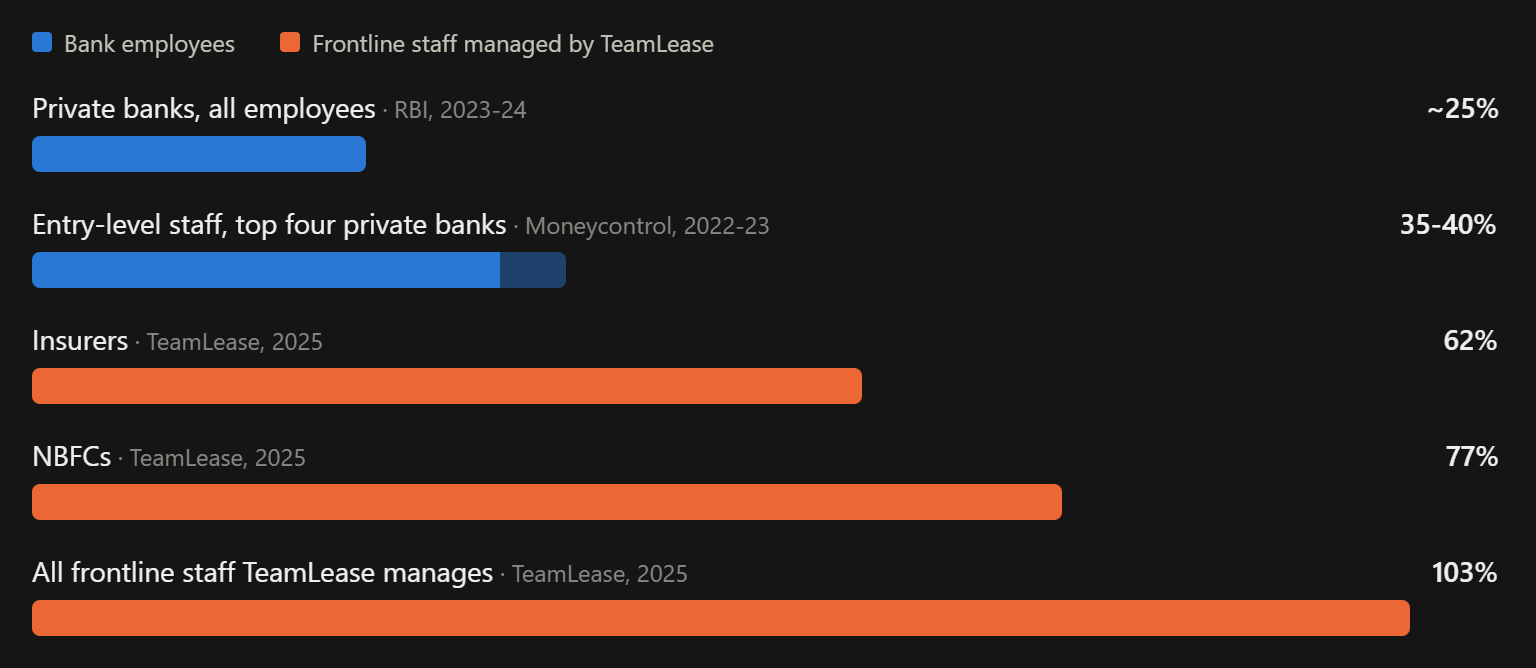
The Reserve Bank of India's Report on Trend and Progress of Banking in India 2023-24 put average attrition in private sector banks at around 25%, up sharply over three years. The RBI called high turnover a significant operational risk, citing disrupted customer service, lost institutional knowledge and higher recruitment costs.
That figure covers all employees. The picture is worse at the entry level. A Moneycontrol analysis of the annual reports of the top four private banks found entry-level attrition of 35-40% in 2022-23, the highest in three years.
Staffing-firm data is higher still. TeamLease, which manages more than 80,000 frontline sales and service staff for banks and non-bank lenders, reported 103% overall attrition across that workforce. This is TeamLease's own managed workforce, not bank employees in general, so don't read it as the attrition rate of banks.
Group | Attrition | Source | Year |
|---|---|---|---|
Private sector banks, all employees | About 25% | RBI, Report on Trend and Progress of Banking in India | 2023-24 |
Entry-level staff, top private banks | 35-40% | Moneycontrol analysis of annual reports | 2022-23 |
TeamLease-managed BFSI frontline staff, overall | 103% | TeamLease Services | 2025 |
TeamLease-managed staff at NBFCs | 77% | TeamLease Services | 2025 |
TeamLease-managed staff at insurers | 62% | TeamLease Services | 2025 |
These numbers are not directly comparable. Some cover every employee and some only frontline staff, and "attrition" is not always defined the same way. Use them as a range, not as one benchmark. Some banks have also seen attrition ease recently, but frontline sales roles remain the hardest to hold.
Why do new RMs leave?
There is rarely one reason, and the causes tend to stack. These are the most common ones.
1. The job isn't the job they were told about. A candidate hears "relationship manager" and expects to manage customers. Then they find the role also means cold calling, lead generation, cross-selling, field visits and monthly reviews against targets. The day looks different in branch banking, in bancassurance and in a virtual relationship manager (VRM) role, and an insurance sales role may also need IRDAI certification. None of this is unusual. The problem is finding out after joining. Tell candidates the target, the incentive structure, how much field work there is, which certifications they need and what kind of customers they will handle, before they accept. Some will say no. That is cheaper than losing them in month three.
2. Induction teaches the product, not the selling. Knowing a loan product and knowing how to pitch it are different skills. A new RM has to practise opening a conversation, handling a "no", following up and building a pipeline. The RBI has recommended better onboarding, training and mentorship as ways to curb attrition. For a new RM, the sequence should be training, practice, feedback, real customer calls, then feedback again. It should not be training followed by being left alone.
3. A target without a process isn't training. A monthly target of some lakhs doesn't tell anyone where leads come from, who to call first or how many follow-ups are normal. A good manager asks "Where are you getting stuck?" and not only "Why are you short?" That one question often exposes a training gap before it turns into a resignation.
4. The manager decides how the first months feel. A new RM spends far more time with the immediate manager than with any induction deck. "Fix your numbers" starts no conversation. "Which part of the process isn't working for you?" does.
5. Salary matters, but it isn't the whole story. Fixed pay, incentives and location all count. But a higher offer won't fix unclear expectations, weak onboarding and no visible career path.
6. No visible next step. A new RM doesn't expect a promotion in six months. They do want to know what good performance leads to: a larger customer book, a senior RM role or branch responsibility. If nobody can say, people start looking elsewhere.
What keeps them: the first 90 days
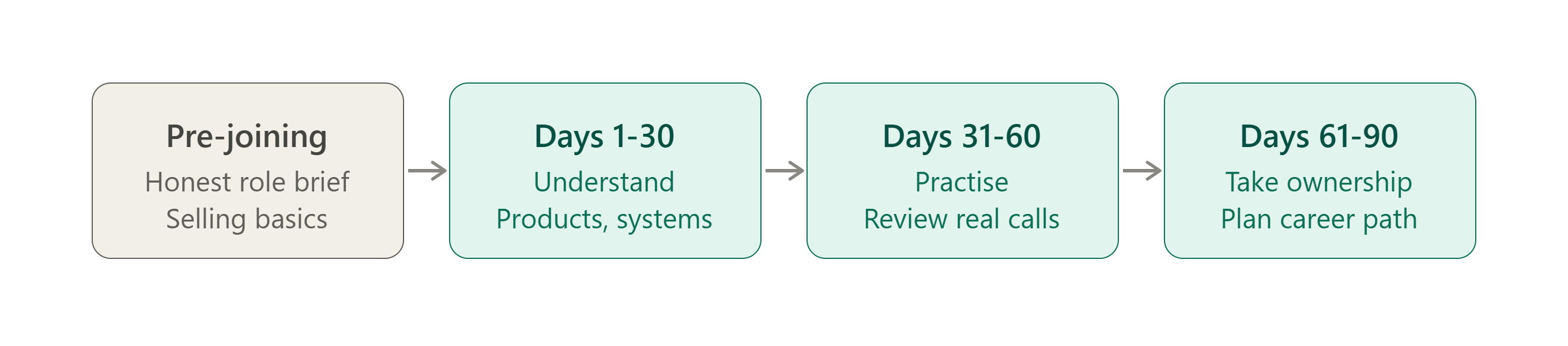
The first 90 days decide a lot. This is when a new RM learns the products, the systems, the customers and what the job really demands. A simple structure helps.
Before joining: give the candidate a plain description of targets, incentives and field work, and train them on products and the sales process.
Days 1-30, understand: products, systems, compliance, customer segments and performance expectations. The goal is a solid foundation, not instant expertise.
Days 31-60, practise: more time with real customers. The manager or mentor reviews calls, follow-ups and pipeline, and looks at the activity behind the number, not just the number.
Days 61-90, take ownership: the RM works more independently. The manager and mentor review progress, spot where support is still needed and talk about the career path.
We run this as a 90-day mentoring programme alongside our train-and-hire work. We place relationship managers and other BFSI sales professionals, and we have trained more than 1,000 people through induction and train-and-hire programmes. Our own retention rate for placed candidates is 95%. We source, train and mentor, because we have seen that hiring is only the first half of the job.
What does one early exit cost?
Add up four things: the cost of recruiting the replacement, the cost of training them, the manager's time spent interviewing and onboarding, and the sales lost while the new person ramps up. Multiply that by every RM who leaves in a year. The total can be far bigger than the cost of the vacancy itself. This is why retention belongs next to hiring speed, offer-to-joining ratio and cost per hire when you judge recruitment performance.
What this means for an HR head
Don't track hiring volume alone. Follow every hire through the full journey: offer, joining, 30 days, 60 days, 90 days, six months, twelve months. Then find where the biggest drop happens.
If candidates accept offers but don't join, look at competing offers, pay, location, notice period and joining delays.
If they leave within 90 days, look at role expectations, onboarding, training and manager support.
If they leave between months four and twelve, look at targets, incentives, career path and workload.
Before your next large hiring drive, ask yourself:
Do candidates get an honest description of the role before the offer?
Are targets and incentives explained before joining?
Do you know why your last batch left?
What share of new hires leave by day 30, 60 and 90?
Do new RMs get practical selling training, not only product training?
Does every new RM have a named mentor for the first 90 days?
Do managers review activity, not just the final number?
Can an RM see a realistic career path?
Do you measure retention alongside hiring volume?
If several answers are no, hiring more people only puts more of them into the same system.
Related reading: Beyond Hiring: Retention Strategies That Actually Work and Top 5 Hiring Trends Reshaping BFSI Recruitment in 2024.
FAQ
What is the average attrition rate for bank relationship managers in India?
There is no single figure. The RBI reports around 25% for private sector banks overall. Entry-level attrition at top private banks was 35-40% in 2022-23. Frontline staff managed by TeamLease showed far higher numbers. The right benchmark depends on the role and how attrition is defined.
Why do relationship managers leave private banks?
Common reasons are a mismatch between the promised and the actual job, targets without training, weak manager support, pay and no visible career path.
Why are the first 90 days so important?
That is when a new RM learns the products, customers and sales process. Regular reviews in this window can catch problems before they become exits.
Is salary the main reason RMs leave?
It is one factor, not the only one. Role clarity, training, manager support and career growth also affect whether people stay.
How should BFSI companies measure early attrition?
Track every hire from offer to joining, then at 30, 60 and 90 days, then at six and twelve months. Write down the definition each time (90-day, first-year, voluntary only), because the figures aren't interchangeable.